Getting a beauty product listed on TikTok Shop isn’t complicated until it is. If you’ve already had a listing rejected with a vague violation message, you’re not alone. This guide breaks down exactly what TikTok Shop requires, why certain listings get flagged, and what compliant listings actually look like.
Guidelines for listing beauty and personal care products on TikTok Shop are the platform’s category-specific rules governing what documentation, ingredient standards, labeling claims, and product types are permitted for sale. These guidelines align with FDA cosmetic regulations and TikTok’s own prohibited items policy, and non-compliance results in listing removal or account suspension.
What TikTok Shop Actually Requires Before You List a Beauty Product
Here’s the thing: TikTok Shop’s Seller University page tells you what to submit. It doesn’t tell you why submissions fail and that gap is where most sellers lose time and listings.
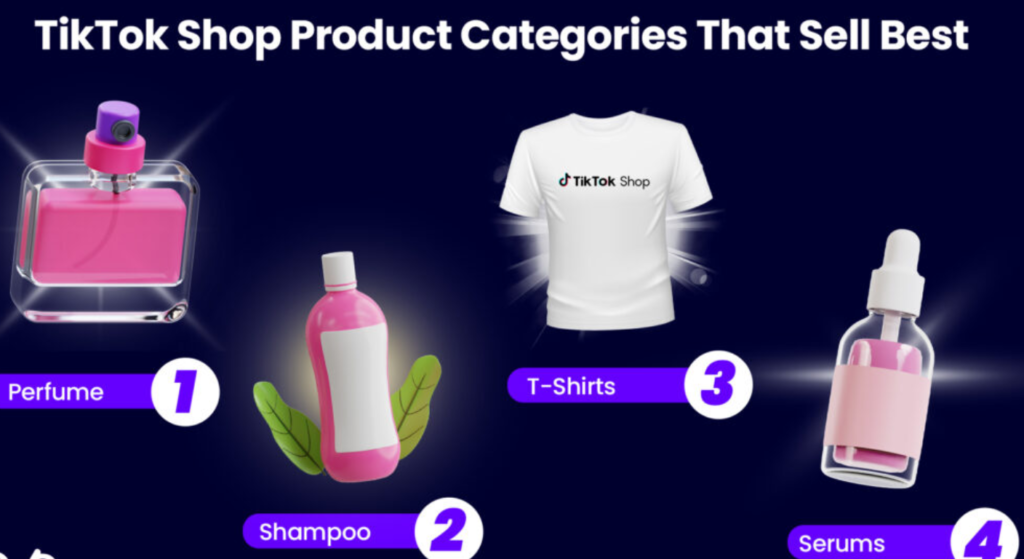
According to TikTok Shop’s Seller University (2024), Beauty & Personal Care is one of the top three best-selling categories on TikTok Shop US. That volume means their review system is aggressive. One wrong word in a product description can trigger an automated flag before a human ever sees your listing.
The baseline documentation requirements for beauty and personal care listings include:
- Certificate of Analysis (COA) issued by a third-party lab, confirming product composition matches label claims
- Safety Data Sheet (SDS) required for products containing potentially reactive ingredients (preservatives, acids, active botanicals)
- Full ingredient list in INCI format International Nomenclature of Cosmetic Ingredients, not marketing names
- Proof of FDA cosmetic facility registration required if you manufacture in the US
- Product label images must match the physical product exactly, including net weight, country of origin, and distributor information
Quick note: if you’re reselling a branded product rather than manufacturing your own, you’ll still need to provide documentation proving the product is authentic and that you’re an authorized reseller. Grey-market beauty imports are a fast track to account suspension.
The Drug Claim Problem Why “Treats Acne” Gets Your Listing Pulled
This is the single most common reason beauty listings get rejected. And it’s the thing TikTok’s own documentation barely explains.
Under FDA definitions, a product becomes a drug the moment it claims to affect the structure or function of the body. Cosmetics, by contrast, are products that affect appearance only. TikTok Shop’s prohibited items policy reflects this distinction directly because selling an unregistered drug on a commerce platform creates serious regulatory liability.
So when your listing says it treats acne, removes wrinkles, reduces inflammation, or stimulates hair regrowth TikTok’s review system reads those as drug claims. Your listing doesn’t get a warning. It gets pulled.
Or maybe I should say it this way: the product itself might be fine. A retinol serum isn’t banned on TikTok Shop. But calling it an anti-aging treatment that restructures skin cells crosses the line.
Compliant vs. Non-Compliant Claim Examples:
| Non-Compliant Claim | Compliant Alternative |
| “Treats acne and clears breakouts” | “Formulated with salicylic acid for a cleaner-looking complexion” |
| “Removes wrinkles permanently” | “Visibly smooths the appearance of fine lines” |
| “Stimulates hair regrowth” | “Supports the look of fuller, thicker hair” |
| “Reduces inflammation” | “Formulated with soothing botanicals for calm-looking skin” |
| “SPF 50 blocks UV rays and prevents skin cancer” | “Broad-spectrum SPF 50 sunscreen” |
The shift is subtle. It’s also non-negotiable.
To get a beauty product listing approved on TikTok Shop, follow these steps:
- Prepare COA, SDS, and INCI ingredient list before starting your upload.
- Review all product claims and remove any language that implies drug-like effects.
- Upload product images that exactly match physical label artwork.
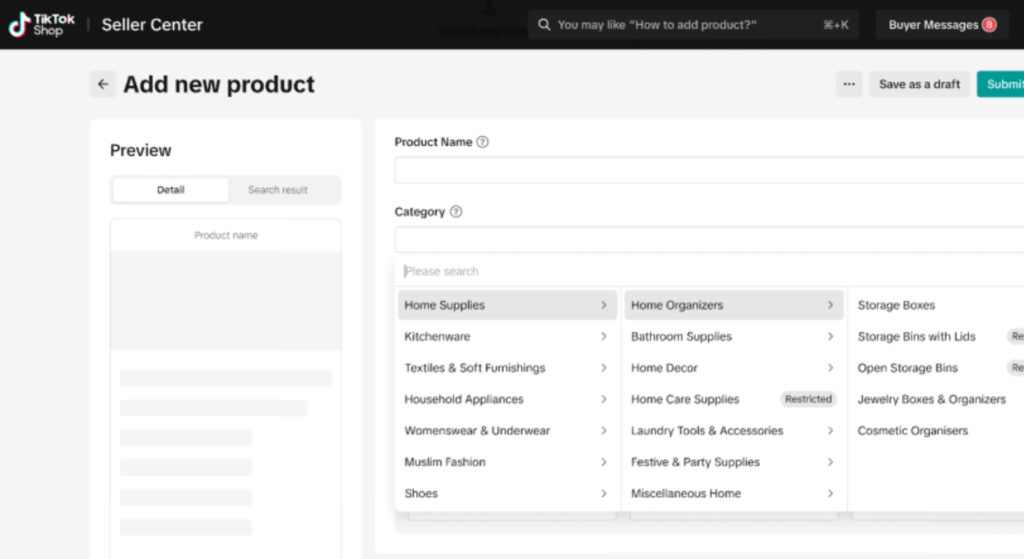
- Submit documentation through TikTok Shop Seller Center during the listing creation flow.
- Monitoring the listing status in Seller Center approval typically takes 1–3 business days.
Prohibited Beauty Products: What TikTok Shop Won’t Let You Sell
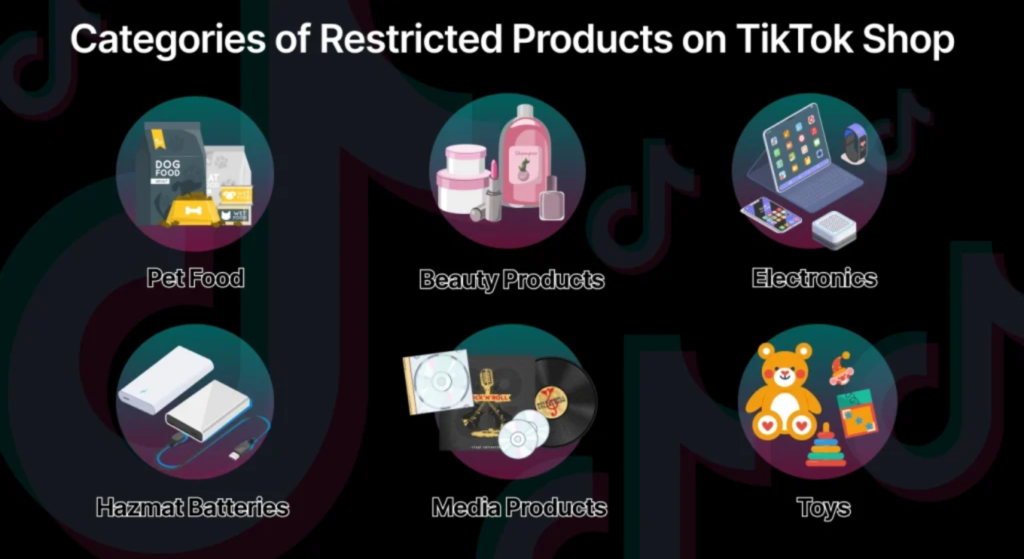
Not everything in the beauty aisle is fair game. TikTok Shop maintains a prohibited and restricted products list that sellers need to review before listing not after.
Products that are outright prohibited include:
- Products containing mercury (a common issue with imported skin-lightening creams)
- Cosmetics making drug claims without FDA drug approval (covered above)
- Counterfeit or grey-market products even if they’re authentic-looking
- Products with undisclosed active pharmaceutical ingredients (some herbal supplements with hidden steroids have been flagged under this)
- Fetal or placental extracts in any form
- Products containing more than 0.3% THC, or any cannabinoid products that make therapeutic claims
Restricted products meaning they can be listed but require additional documentation include:
- Sunscreens must include SPF testing reports and comply with FDA OTC monograph requirements
- Products with AHA/BHA concentrations above certain thresholds platform may request pH testing documentation
- Keratin treatments containing formaldehyde or formaldehyde-releasing agents
- Teeth whitening products above certain peroxide concentrations
Some experts argue that TikTok is more lenient on beauty compliance than Amazon. That’s valid for basic skincare SKUs with clean ingredient lists. But if you’re dealing with functional activities, import products, or anything adjacent to therapeutic claims, TikTok’s review system is comparably strict and their appeals process is slower.
How to Organize Your Compliance Documentation (Before It’s a Crisis)
Most sellers don’t think about documentation organization until they’re three listings deep and their fourth gets rejected. Don’t be that seller.
The practical approach is to build a master compliance folder Google Drive works fine organized by SKU. For each product, you want:
- A folder named by SKU or product name
- Inside: COA (PDF), SDS (PDF), INCI list (text file or spreadsheet), label artwork (high-res PNG), and any third-party test results
- A single-row entry in a tracking spreadsheet noting document dates, lab names, and expiry (COAs are typically valid for 12–24 months)
Tools like Typeform can help if you’re working with a contract manufacturer build a simple intake form that captures all documentation at the point of formulation approval, before you ever think about listing. That way, you’re not chasing paperwork when you’re ready to go live.
TikTok Shop Seller Center itself has a document upload interface during the listing flow. It’s functional but not sophisticated; you’re uploading files, not building a structured compliance record. The organizational work happens on your end.
Selling beauty products on TikTok Shop vs. Amazon:
TikTok Shop is better suited for trend-driven, visual beauty products because short-form video drives discovery organically. Amazon works better when buyers are searching by specific ingredient or brand name. The key difference is that TikTok Shop’s compliance review is faster but less transparent Amazon’s process is slower but provides more detailed rejection reasons.
Quick Comparison: Beauty Listing Requirements Across Platforms
| Platform | COA Required | Drug Claim Policy | Review Timeline | Appeals Process |
| TikTok Shop US | Yes, for most categories | Strict — automated + human review | 1–3 business days | In-Seller Center, 3–5 days |
| Amazon US | Yes, for topicals/OTC | Strict — ASIN suppression | 3–7 business days | Seller Central case, variable |
| Etsy | Rarely required | Self-policed, lower enforcement | Immediate (live on publish) | Community standards report |
| Shopify (own store) | Not required by platform | Self-regulated, FTC standards apply | N/A | N/A |
This works best for sellers comparing TikTok Shop to other platforms they’ve used. It won’t resolve marketplace-specific edge cases not covered in this table.
What Most Guides Skip: The Label Artwork Trap
I’ve seen conflicting data on this; some seller communities say TikTok’s image review is primarily automated and catches obvious issues only, while others report manual reviews flagging subtle label discrepancies. My read is that both are true at different volume thresholds: high-volume or high-risk categories (like SPF products or anything with active ingredients) get more human review time.
Here’s what that means practically: your product images in TikTok Shop must match the physical label. Exactly.
If your label says 8 fl oz and your listing image shows a prototype label that says 250ml that’s a flag. If your INCI list submitted to TikTok includes an ingredient that isn’t visible on the label artwork you uploaded, that’s a flag. If your hero image shows the product without a label because it looks cleaner that’s a flag.
What most guides skip is this: TikTok Shop’s review team cross-references your uploaded documentation against your product images. They’re not just checking that you uploaded something they’re checking for internal consistency. A COA that doesn’t match the product name in your listing title will get caught.
FAQs
Q: What documents do I need to list beauty products on TikTok Shop?
A: You’ll typically need a Certificate of Analysis (COA), Safety Data Sheet (SDS), full INCI ingredient list, product label images, and proof of authorized reseller status or manufacturing facility registration. Sunscreens require additional SPF testing documentation.
Q: Why does TikTok Shop keep rejecting my skincare listing?
A: The most common reasons are drug-claim language in the title or description (words like treats, heals, or cures), missing or mismatched documentation, and label images that don’t match the submitted ingredient list. Review your product claims first that’s where 80% of rejections originate.
Q: How do I know if my beauty product claim is a drug claim on TikTok Shop?
A: If your claim says the product affects the body’s structure or function — not just its appearance it’s likely a drug claim. Visibly reducing the look of wrinkles is cosmetic. Reduces wrinkles by rebuilding collagen is a drug claim. When in doubt, remove any language implying a biological mechanism.
Q: Should I list sunscreen as a cosmetic or drug on TikTok Shop?
A: Sunscreens are regulated as OTC drugs by the FDA, and TikTok Shop treats them accordingly. You’ll need SPF testing documentation and must comply with FDA OTC monograph requirements. Listing them accurately mislabeling sunscreen as a cosmetic is one of the fastest ways to get a listing pulled.
Q: When should I appeal a rejected beauty product listing on TikTok Shop?
A: Appeal only after you’ve corrected the underlying issue updated the claims language, uploaded the missing documentation, or fixed the label image discrepancy. Appealing without changes rarely succeeds and may delay your listing further. Fix first, then appeal with a clear note explaining what you changed.